Showing posts with label lucene. Show all posts

Tuesday, January 16, 2018

New Luke on JavaFX

Hello and Happy New Year to my readers!

I'm happy to announce release of completely reimplemented Luke -- using JavaFX technology.  Luke is the toolbox for analyzing and maintaining your Lucene / Solr / Elasticsearch index on low level. 

The implementation was contributed by Tomoko Uchida, who also did the honors of releasing it.

The excitement of this release is supported by the fact, that in this version Luke becomes fully compliant with ALv2 license! And it gets very close to be contributed to Lucene project. At this point we need lots of testing to make sure JavaFX version is on par with the original thinlet based one.

Here is how load index screen looks like in new JavaFX luke:


After navigating to the Solr 7.1 index and pressing OK, here is what luke shows:


I have loaded an index of Finnish wikipedia with 1,069,778 documents, and luke tells me that the index does not have deletions and was not optimized. Let's go ahead and optimize it:


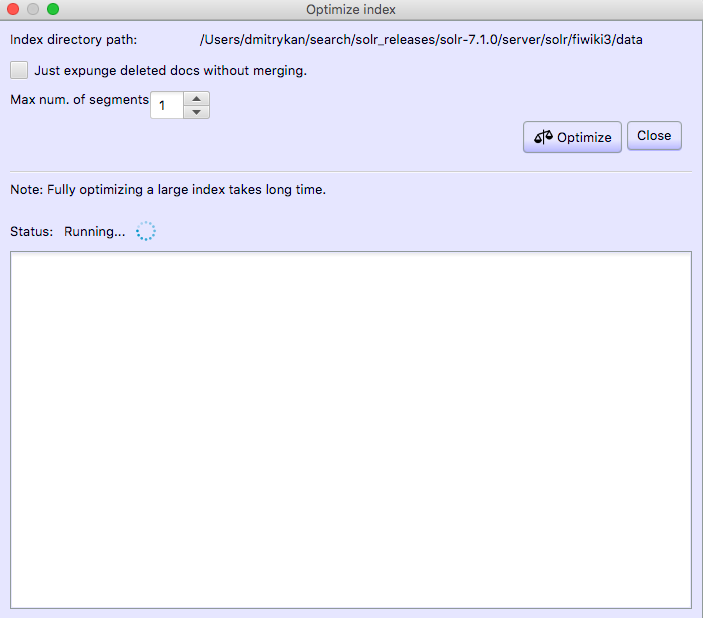
Notice, that on this dialogue you can request only expunging of deleted docs, without merging (the costly part for large indices). After optimization's complete, you'll have a full log of actions in front of you to confirm the operation was successful:


You could also opt for checking the health of your index via Tools -> Check index menu item:


Let's move to the Search tab. It has changed slightly in that search box has moved to the right, while search settings and other knobs were moved to the left.

Thinlet version:


JavaFX version:


It is more intuitive UI now in terms of access to various tools like Analyzer, Similarity (now with access to parameters of new BM25 ranking model, that became default in Lucene and default in luke) and More Like This. There is a new Sort sub-tab that lets you choose a primary and secondary field to sort on. Collectors tab however is gone: please let us know, if you used it for some task -- would love to learn.

Moving on to the Analysis tab, I'd like to draw your attention towards really cool functionality of loading custom jars with your implementation of a character filter, tokenizer or token filter to form your custom analyzer. Test these right in the luke UI without the need to reload shards in your Solr / Elasticsearch installation:


Last, but not least is Logs tab. Essentially you should have been missing it for as long as luke exists: getting a handle of what's happening behind the scenes during an error case or a normal operation.

In addition, this version of Luke supports the recently released Lucene 7.2.0.

Sunday, October 9, 2016

Luke 6.2.1 release and all things open source

Release

Indeed, luke 6.2.1 for lucene 6.2.1 is out of the oven. This is the proud moment for Tomoko Uchida, my co-committer to have been a release manager for the first time. Congrats, Tomoko!

Community

As luke gets more and more stargazers on github (520 at the time of this writing), I tend to glance over the list of them which sometimes makes my day. But beyond that and more importantly, this lays out the community of Lucene / Solr / Elasticsearch users and developers, that hopefully enjoy using luke too. 

Big names on user list

Having access to the stats of the luke repo gives insights on who and when might be talking about luke. This time, it is PayPal Engineering. And here is their nice technical writeup on indexing lots of data in Elasticsearch and field usage of luke for optimizing the lucene index data structures: https://www.paypal-engineering.com/2016/08/10/powering-transactions-search-with-elastic-learnings-from-the-field/

London Lucene/Solr hackday

Hackday is an amazing way to jump out of a routine and think big: what can be improved in the search land of Lucene / Solr technology and tooling? It was great to see that luke was picked up as one topic on the Lucene / Solr hackday in London: https://github.com/flaxsearch/london-hackday-2016. And there it is, Marple, browser-driven explorer for lucene indexes: https://github.com/flaxsearch/marple. Go check it out.

New contributors to luke

Tomoko and I have been active promoting luke on various occasions, Lucene / Solr Revolution 2015 and  ApacheCon 2015. And of course on twitter. Recently Florian Hopf has become active in sending pull requests to improve luke and fix various nagging issues. Welcome!

Wednesday, April 13, 2016

Luke 6.0 has been released

#luke 6.0 has been released. Major upgrade to #lucene 6.0 api: https://github.com/DmitryKey/luke/releases/tag/luke-6.0.0


There are other interesting features cooking, like access to DocValues: https://github.com/DmitryKey/luke/pull/53

If you feel like contributing, either by code or documentation, feel free to join the project:


Wednesday, December 30, 2015

Apache Solr Enterprise Search Server -- Third edition

This year gave me a chance to be a technical reviewer of the book with search engine topic. The title is Apache Solr Enterprise Search Server and it saw the light in its third edition. The first edition back in 2010 helped me to start thinking in NoSQL way, despite that SQL has been literally everywhere (well, and still is). It does take a bit of mind warping to think beyond relational database lingo and data modelling and in my opinion is rather useful for your career as a software engineer.


Here goes my review on Amazon:

This book in its first edition was the first one around back in 2010, that covered Apache Solr in as much detail as I needed to get into the topic quickly. This third edition includes revisions for Apache Solr 5, notoriously covering things like Solr admin page, SolrCloud, scaling the search engine for large amount of documents, text analysis, indexing, search and even map-reducing your Solr index! In particular, throwing a MapReduce task at large-scale indexing task has been hard / unclear in the past and now it is available to any user of Apache Solr out of the box. This makes books like this immensely important to not waste one's time in looking around for useful bits of information scattered here and there. More importantly, authors of the book are directly involved into the project, either as Apache Solr / Lucene committers or active practitioners and developers of the technology. So I recommend this book for an entry-level and mid-level search engineers that look into getting their hands dirty with search problems and / or improving on the previously untapped areas of the search engine world.

Sunday, October 11, 2015

[ANNOUNCE] Luke 5.3.0 released: naturally runs on Java 8

This release runs on Java8 and does not run on Java7.

This release includes a number of pull requests and github issues. Worth mentioning:
#38 upgrade to 5.3.0 itself
#28 Added LUKE_PATH env variable to luke.sh
#35 Added copy, cut, paste etc. shortcuts, using Mac command key
#34 Fixed lastAnalyzer retrieval (this feature remembers the last used analyzer on the Search tab)
#31 200 stargazers on github (by the time of this release the number crossed 260). Luke community is growing.

Everybody is welcome to contribute. If you feel like you care about search / indexing or would like to get deeper with Apache Lucene, go ahead and pick a ticket: https://github.com/DmitryKey/luke/issues
And, don't be afraid, we do not have any complaint departments:


All you need is your favourite beverage and a good debugger.

Wednesday, July 8, 2015

[ANNOUNCE] Luke 5.2.0 released

This is a major release supporting lucene / solr 5.2.0. Download the zip here:

It supports elasticsearch 1.6.0 (lucene 4.10.4)
Issues fixed:
#20 Added support for reconstructing field values of indexed and not stored fields, that do not expose positions.
Pull requests:
#23 Elasticsearch support and Shade plugin for assembly
#26 added .gitignore to project
#27 Lucene 5x support
#28 Added LUKE_PATH env variable to luke.sh
#30 Luke 5.2

I'd like to highlight the contribution of Tomoko Uchida who has been recently very active in sending pull requests, including upgrade to lucene 5.x and first version of Apache Pivot based luke ui.

Wednesday, April 15, 2015

Luke gets support for Elasticsearch indices

That is that, really. The so long awaited proper support for elasticsearch indices.


Luke supported Apache Solr indices already. Why not Elasticsearch? The reason was, that ES uses its own SPI for postings format. If you tried to open an Elasticsearch index with luke before, you'd get something like:

A SPI class of type org.apache.lucene.codecs.PostingsFormat with name 'es090' does not exist. You need to add the corresponding JAR file supporting this SPI to your classpath. The current classpath supports the following names: [Lucene40, Lucene41]


The biggest issue of supporting custom SPI is that you'd need to hack the luke jar binary and add the ES SPI. I bet it is not what you would want to spend your time on.

With the excellent pull request by apakulov https://github.com/DmitryKey/luke/pull/23 luke uses shade maven plugin, that does all the magic. It magically updates the in-binary META-INF/services file with the following entry:

org.elasticsearch.index.codec.postingsformat.Elasticsearch090PostingsFormat
org.elasticsearch.search.suggest.completion.Completion090PostingsFormat
org.elasticsearch.index.codec.postingsformat.BloomFilterPostingsFormat


Currently this is available on luke master: https://github.com/DmitryKey/luke and a pre-release: https://github.com/DmitryKey/luke/releases/tag/luke-4.10.4-field-reconstruction

Monday, March 16, 2015

Luke keeps getting updates and now on Apache Pivot

Originally developed for fun and profit by Andrzej Bialecki, the lucene toolbox luke continues to be developed. Its releases are published at: https://github.com/DmitryKey/luke/releases


Most recently Tomoko Uchida has contributed into effort of porting Luke to an Apache License 2.0 friendly GUI framework Apache Pivot. New branch has been created to host this work:

https://github.com/DmitryKey/luke/tree/pivot-luke

Currently supported Lucene: 4.10.4.

It is far from completion, but already now you can:

  • open your Lucene index and check its metadata

  • page through the documents and analyze fields


  • search the index

We will appreciate if you could test the pivot luke and give your feedback.

Wednesday, September 17, 2014

Exporting Lucene index to xml with Luke

Luke is the open source Lucene toolbox originally written by Andrzej Bialecki and currently maintained by yours truly. The tool allows you to introspect into your solr / lucene index, check it for health, fix problems, verify field tokens and even experiment with scoring or read the index from HDFS.

In this post I would like to illustrate one particular luke's feature, that allows you to dump index into an xml for external processing.

Task

Extract indexed tokens from a field to a file for further analysis outside luke.


Indexing data

In order to extract tokens you need to index your field with term vectors configured. Usually, this also means, that you need to configure positions and offsets.

If you are indexing using Apache Solr, you would configure the following on your field:

<field indexed="true" name="Contents" omitnorms="false" stored="true" termoffsets="true" termpositions="true" termvectors="true" type="text">

With this line you make sure you field is going to store its contents, not only index; it will also store the term vectors, i.e. a term, its positions and offsets in the token stream.


Extracting index terms

One way to view the indexed tokens with luke is to search / list documents, select the field with term vectors enabled and click TV button (or right-click and choose "Field's Term Vector").


If you would like to extract this data into an external file, there is a way currently to accomplish this via menu Tools->Export index to XML:


In this case I have selected the docid 94724 (note, that this is lucene's internal doc id, not solr application level document id!), that is visible when viewing a particular document in luke. This dumps a document into the xml file, including the fields in the schema and each field's contents. In particular, this will dump the term vectors (if present) of a field, in my case:

<field flags="Idfp--SV-Nnum--------" name="Contents">
<val>CENTURY TEXT.</val>
<tv>
<t freq="1" offsets="0-7" positions="0" text="centuri" />
<t freq="1" offsets="0-7" positions="0" text="centuryä" />
<t freq="1" offsets="8-12" positions="1" text="text" />
<t freq="1" offsets="8-12" positions="1" text="textä" />
</tv>
</field>

Monday, June 9, 2014

Low-level testing your Lucene TokenFilters

On the recent Berlin buzzwords conference talk on Apache Lucene 4 Robert Muir mentioned the Lucene's internal testing library. This library is essentially the collection of classes and methods that form the test bed for Lucene committers. But, as a matter of fact, the same library can be perfectly used in your own code. David Weiss has talked about randomized testing with Lucene, which is not the focus of this post but is really a great way of running your usual static tests with randomization.

This post will show a few code snippets, that illustrate the usage of the Lucene test library for verifying the consistency of your custom TokenFilters on lower level, than your might used to.


(Credits: http://blog.csdn.net/caoxu1987728/article/details/3294145 
I'm putting this fancy term graph to prove, that posts with images are opened more often, than those without. Ok, it has relevant parts too: in particular we are looking into creating our own TokenFilter in parallel to StopFilter, LowerCaseFilter, StandardFilter and PorterStemFilter.).


In the naming convention spirit of the previous post, where custom classes started with GroundShaking prefix, let's create our own MindBlowingTokenFilter class. For the sake of illustration, our token filter will take each term from the term stream, add "mindblowing" suffix to it and store in the stream as a new term. This class will be a basis for writing unit-tests.

package com.dmitrykan.blogspot;

import org.apache.lucene.analysis.TokenFilter;
import org.apache.lucene.analysis.TokenStream;
import org.apache.lucene.analysis.tokenattributes.CharTermAttribute;
import org.apache.lucene.analysis.tokenattributes.PositionIncrementAttribute;
import org.apache.lucene.analysis.tokenattributes.PositionLengthAttribute;

import java.io.IOException;

/**
 * Created by dmitry on 6/9/14.
 */
public final class MindBlowingTokenFilter extends TokenFilter {

    private final CharTermAttribute termAtt;
    private final PositionIncrementAttribute posAtt;
    // dummy thing, is needed for complying with BaseTokenStreamTestCase assertions
    private PositionLengthAttribute posLenAtt; // don't remove this, otherwise the low-level test will fail

    private State save;

    public static final String MIND_BLOWING_SUFFIX = "mindblowing";

    /**
     * Construct a token stream filtering the given input.
     *
     * @param input
     */
    protected MindBlowingTokenFilter(TokenStream input) {
        super(input);
        this.termAtt = addAttribute(CharTermAttribute.class);
        this.posAtt = addAttribute(PositionIncrementAttribute.class);
        this.posLenAtt = addAttribute(PositionLengthAttribute.class);
    }

    @Override
    public boolean incrementToken() throws IOException {
        if( save != null ) {
            restoreState(save);
            save = null;
            return true;
        }

        if (input.incrementToken()) {
            // pass through zero-length terms
            int oldLen = termAtt.length();
            if (oldLen == 0) return true;
            int origOffset = posAtt.getPositionIncrement();

            // save original state
            posAtt.setPositionIncrement(0);
            save = captureState();

            //char[] origBuffer = termAtt.buffer();

            char [] buffer = termAtt.resizeBuffer(oldLen + MIND_BLOWING_SUFFIX.length());

            for (int i = 0; i < MIND_BLOWING_SUFFIX.length(); i++) {
                buffer[oldLen + i] = MIND_BLOWING_SUFFIX.charAt(i);
            }

            posAtt.setPositionIncrement(origOffset);
            termAtt.copyBuffer(buffer, 0, oldLen + MIND_BLOWING_SUFFIX.length());

            return true;
        }
        return false;
    }
}

The next thing we would like to do is to write a Lucene-level test suite for this class. We will extend it from BaseTokenStreamTestCase, not standard TestCase or other class from a testing framework you might have used to deal with. The reason being we'd like to utilize the internal Lucene's test functionality, that lets you access and cross check the lower-level items, like term position increments, position lengths, position start and end offsets etc.

About the same information you can see with Apache Solr's analysis page, if you enable verbose mode. While the analysis page is good to visually debug your code, the unit test is meant to run for you every time you change and build you code. If you decide to first visually examine the term positions, start and end offsets with Solr, you'll need to wrap the token filter into factory and register it in the schema on your field type. The factory code:

package com.dmitrykan.blogspot;

import org.apache.lucene.analysis.TokenStream;
import org.apache.lucene.analysis.util.TokenFilterFactory;

import java.util.Map;

/**
 * Created by dmitry on 6/9/14.
 */
public class MindBlowingTokenFilterFactory extends TokenFilterFactory {
    public MindBlowingTokenFilterFactory(Map args) {
        super(args);
    }

    public MindBlowingTokenFilter create(TokenStream input) {
        return new MindBlowingTokenFilter(input);
    }

}

Here is the test class in all its glory.

package com.dmitrykan.blogspot;

import org.apache.lucene.analysis.Analyzer;
import org.apache.lucene.analysis.BaseTokenStreamTestCase;
import org.apache.lucene.analysis.MockTokenizer;
import org.apache.lucene.analysis.Tokenizer;

import java.io.IOException;
import java.io.Reader;

/**
 * Created by dmitry on 6/9/14.
 */
public class TestMindBlowingTokenFilter extends BaseTokenStreamTestCase {
    private Analyzer analyzer = new Analyzer() {
        @Override
        protected TokenStreamComponents createComponents(String fieldName, Reader reader) {
            Tokenizer source = new MockTokenizer(reader, MockTokenizer.WHITESPACE, true);
            return new TokenStreamComponents(source, new MindBlowingTokenFilter(source));
        }
    };

    public void testPositionIncrementsSingleTerm() throws IOException {

        String output[] = {"queries" + MindBlowingTokenFilter.MIND_BLOWING_SUFFIX, "queries"};
        // the position increment for the first term must be one in this case and of the second must be 0,
        // because the second term is stored in the same position in the token filter stream
        int posIncrements[] = {1, 0};
        // this is dummy stuff, but the test does not run without it
        int posLengths[] = {1, 1};

        assertAnalyzesToPositions(analyzer, "queries", output, posIncrements, posLengths);
    }

    public void testPositionIncrementsTwoTerm() throws IOException {

        String output[] = {"your" + MindBlowingTokenFilter.MIND_BLOWING_SUFFIX, "your", "queries" + MindBlowingTokenFilter.MIND_BLOWING_SUFFIX, "queries"};
        // the position increment for the first term must be one in this case and of the second must be 0,
        // because the second term is stored in the same position in the token filter stream
        int posIncrements[] = {1, 0, 1, 0};
        // this is dummy stuff, but the test does not run without it
        int posLengths[] = {1, 1, 1, 1};

        assertAnalyzesToPositions(analyzer, "your queries", output, posIncrements, posLengths);
    }

    public void testPositionIncrementsFourTerms() throws IOException {

        String output[] = {
                "your" + MindBlowingTokenFilter.MIND_BLOWING_SUFFIX, "your",
                "queries" + MindBlowingTokenFilter.MIND_BLOWING_SUFFIX, "queries",
                "are" + MindBlowingTokenFilter.MIND_BLOWING_SUFFIX, "are",
                "fast" + MindBlowingTokenFilter.MIND_BLOWING_SUFFIX, "fast"};
        // the position increment for the first term must be one in this case and of the second must be 0,
        // because the second term is stored in the same position in the token filter stream
        int posIncrements[] = {
                1, 0,
                1, 0,
                1, 0,
                1, 0};
        // this is dummy stuff, but the test does not run without it
        int posLengths[] = {
                1, 1,
                1, 1,
                1, 1,
                1, 1};

        // position increments are following the 1-0 pattern, because for each next term we insert a new term into
        // the same position (i.e. position increment is 0)
        assertAnalyzesToPositions(analyzer, "your queries are fast", output, posIncrements, posLengths);
    }

    public void testPositionOffsetsFourTerms() throws IOException {

        String output[] = {
                "your" + MindBlowingTokenFilter.MIND_BLOWING_SUFFIX, "your",
                "queries" + MindBlowingTokenFilter.MIND_BLOWING_SUFFIX, "queries",
                "are" + MindBlowingTokenFilter.MIND_BLOWING_SUFFIX, "are",
                "fast" + MindBlowingTokenFilter.MIND_BLOWING_SUFFIX, "fast"};
        // the position increment for the first term must be one in this case and of the second must be 0,
        // because the second term is stored in the same position in the token filter stream
        int startOffsets[] = {
                0, 0,
                5, 5,
                13, 13,
                17, 17};
        // this is dummy stuff, but the test does not run without it
        int endOffsets[] = {
                4, 4,
                12, 12,
                16, 16,
                21, 21};

        assertAnalyzesTo(analyzer, "your queries are fast", output, startOffsets, endOffsets);
    }

}

All tests should pass and yes, the same numbers are present on the Solr's analysis page:


MindBlowingTokenFilter solr analysis page


Happy unit testing with Lucene!

your @dmitrykan

Monday, March 31, 2014

Implementing own LuceneQParserPlugin for Solr

Whenever you need to implement a query parser in Solr, you start by sub-classing the LuceneQParserPlugin:


public class MyGroundShakingQueryParser 
                           extends LuceneQParserPlugin {
    public QParser createParser(String qstr, 
                                SolrParams localParams,
                                SolrParams params,
                                SolrQueryRequest req) {}
}

In this way you will reuse the underlining functionality and parser of the LuceneQParserPlugin. The grammar of the parser is defined in QueryParser.jj file inside Lucene/Solr source code tree.

The grammar that QueryParser.jj uses is BNF. The JavaCC tool implements parsing of such grammars and producing the java code for you. The produced code is effectively a parser with built-in validation etc.

In Solr there is its own version of LuceneQParserPlugin: it is called QParserPlugin and in fact it pretty much implements almost the same functionality as its counterpart.

There could be use cases for customization of the lucene parsing grammar (stored in QueryParser.jj). Once the customization is done (let's rename the jj file to GroundShakingQueryParser.jj), we invoke the javacc tool and it produces a GroundShakingQueryParser.java and supplementary classes. In order to wire it into the Solr we need to do a few things. The final class inter-play is shown on the class diagram:

class diagram of inter-relations between classes
Going bottom up:
1. You implement your custom logic in GroundShakingQueryParser.jj that produces GroundShakingQueryParser.java. Make sure the class extends SolrQueryParserBase.
2. To wire this into Solr, we need to extend the GroundShakingQueryParser class in GroundShakingSolrQueryParser class.

/**
 * Solr's default query parser, a schema-driven superset of the classic lucene query parser.
 * It extends the query parser class with modified grammar stored in GroundShakingQueryParser.jj.
 */
public class GroundShakingSolrQueryParser extends GroundShakingQueryParser {

  public GroundShakingSolrQueryParser(QParser parser, String defaultField) {
    super(parser.getReq().getCore().getSolrConfig().luceneMatchVersion, defaultField, parser);
  }

}

3. Instance of GroundShakingSolrQueryParser is acquired in the GroundShakingLuceneQParser class.

class GroundShakingLuceneQParser extends QParser {
    GroundShakingSolrQueryParser lparser;

    public GroundShakingLuceneQParser(String qstr, SolrParams localParams, SolrParams params, SolrQueryRequest req) {
        super(qstr, localParams, params, req);
    }


    @Override
    public Query parse() throws SyntaxError {
        String qstr = getString();
        if (qstr == null || qstr.length()==0) return null;

        String defaultField = getParam(CommonParams.DF);
        if (defaultField==null) {
            defaultField = getReq().getSchema().getDefaultSearchFieldName();
        }
        lparser = new GroundShakingSolrQueryParser(this, defaultField);

        lparser.setDefaultOperator
                (GroundShakingQueryParsing.getQueryParserDefaultOperator(getReq().getSchema(),
                        getParam(QueryParsing.OP)));

            return lparser.parse(qstr);
    }


    @Override
    public String[] getDefaultHighlightFields() {
        return lparser == null ? new String[]{} : new String[]{lparser.getDefaultField()};
    }

}


4. GroundShakingLuceneQParser is wired into GroundShakingQParserPlugin that extends the aforementioned QParserPlugin.


public class GroundShakingQParserPlugin extends QParserPlugin {
  public static String NAME = "lucene";

  @Override
  public void init(NamedList args) {
  }

  @Override
  public QParser createParser(String qstr, SolrParams localParams, SolrParams params, SolrQueryRequest req) {
    return new GroundShakingLuceneQParser(qstr, localParams, params, req);
  }
}


5.  Now we have our custom GroundShakingLuceneQParser which can be directly extended in our MyGroundShakingQueryParser!

public class MyGroundShakingQueryParser 
                           extends GroundShakingLuceneQParserPlugin {
    public QParser createParser(String qstr, 
                                SolrParams localParams,
                                SolrParams params,
                                SolrQueryRequest req) {}
}

To register the MyGroundShakingQueryParser in solr, you need to add the following line into solrconfig.xml:

<queryparser class="com.groundshaking.MyGroundShakingQueryParser" name="groundshakingqparser"/ >


To use it, just specify the name in the defType=groundshakingqparser as a query parameter to Solr.


By the way, one convenience of this implementation is that we can deploy the above classes in a jar under solr core's lib directory. I.e. we do not need to overhaul solr source code and deal with deploying some "custom" solr shards.


Monday, December 16, 2013

Lucene Toolbox Luke

As I was mentioning in some of the previous posts, I have been working on luke, the Lucene Toolbox. Recently, the releases have been more or less steady, providing the binaries right on the github site.


Here is the most recent release of luke for the most recent release of Lucene 4.6.0:

port to Lucene 4.6.
Tested against the solr-4.6 index of exampledocs xml files.
Changelist:
1. bumped up the version of maven-assembly plugin to the latest 2.4
2. added maven-jar plugin which copies all binary dependencies into lib/ subdirectory
3. Fixed AnalyzerToolPlugin to use token stream reset outside while loop over tokens
4. added lock factory handling in FsDirectory (untested)
5. updated trivia in about.xml

At the moment the generated all-inclusive jar can be launched by double-clicking it only. There is some work to do to enable command line launches.

If you feel like contributing (patches and new features alike) and enjoy using the tool, get in touch or just send a pull request.

Enjoy the season's holidays,

Wednesday, November 13, 2013

Lucene Revolution EU 2013 in Dublin: Day 2

This post tells my impressions of the Lucene Revolution conference held in Dublin, Ireland, 2013, day 2. The day 1 is described here.

Second day was slightly tougher to start right after the previous evening in a bar with committers and conference participants, but good portion of full Irish breakfast with coffee helped a lot and set me up for the day.

I decided to postpone coming to the conference venue (Aviva stadium) right until the technical presentations started. But, I was in early enough still to make it to the panel with Paul Doscher. Paul holds himself quite professionally and talks in a convincing manner. He didn't seem to be a BS CEO, and tries best to address the question at hand as deeply and low-level as possible. May be EU audience was a bit sleepy or a not too comfortable talking otherwise (geeks, geeks), which didn't spawn as many discussions / questions. Two Paul's questions that come to mind:


1. Have you been doing search / big data during past 4-5 years?
2. Do you think the search / big data is a good area to stay until end of your IT career?

There have been more hands for 1 than for 2. Which in Paul's mind was a bit strange as he strongly believes search and big data is the area to stay. There is so much complexity involved and so much data has been accumulated by enterprises that there will be a strong demand in specialists of this sort. While I would second this, I can tell that the consumers of enterprise data will have higher standards to quality, because they do business with it. On the other hand, in my opinion, if you take so called mass media (microblogs, forums, user sentiment and so on), there is also big data produced at high speeds, but the user base on average is not as demanding. It is again businesses that will likely to be interested to sift some signal from the mass media noise.

Coming back to the technical presentations.

The first technical presentation I visited has been "Lucene Search Essentials: Scorers, Collections and Custom Queries" by +Mikhail Khludnev. I know Mikhail since more than a year ago, sitting on the same Solr user mail-list and commenting on SORL jira.

His team has been doing some really low-level stuff with Solr / Lucene code for e-commerce and this presentation has summarized his knowledge pretty much. I'd say while the presentation is accessible for a non-prepared audience, it goes quite deep into analyzing compexities of certain search algorithms and lays a background for more conscious search. The slides.

On the next session Isabel Drost-Fomm introduced the audience into the world of text classification and Apache Mahout. Isabel is a co-founder of another exciting conference on search and related technologies Berlin Buzzwords and is a Mahout committer.


Before the session Isabel mentioned to me, that one of the targets of her presentation is let people know the existing good systems like Lucene with tokenizers and focus on solving a particular task at hand instead of reinventing a wheel. Good intro level presentation, and after trying out Mahout, I must say you can get going with the examples quite easily. Isabel had mentioned that becoming a committer in the Apache community is easier than one might think: fix or write new documentation, attach small patches (not necessarily code) and that might be enough. But, removing yourself from the committer status is much harder, because, if I sensed it right, Apache has rather wide network of reminding you to commit. So you might find yourself coding over the weekend for Open Source. Which, in the long run,  may make a good career boost for you.

In the lobbies some folks wanted to chat about luke project, that I have been contributing lately. Finally added its creator Andrzej Bialecki as a contributor. If you enjoy using luke and want to make it better, feel free to join and start contributing yummy patches!

The next cool presentation was presented by Alan Woodward and Charlie Hull (who published a nice writeup on the conference here and here). Their collaborative talk focused on turning the search upside down: queries become documents and documents become queries (honestly, I would like to see how this is handled in the code in terms of naming the variables and functions). Charlie briefly mentioned that the code will be open-sourced. The specific use case for this is a bank of queries or a taxonomy of queries (for instance, for patent examiners) that need to be executed against each incoming document. If there is a hit, this document gets the query id as some concept. What I liked in the presentation is the innovative look on the problem: given a set of queries, what is the efficient representation of them in the Lucene index? For example a SpanNear query can be represented as an AND on its operands, then  the AND query can be checked only for one operand quickly and efficiently. If it is not present, the entire query is not hitting the document. They also used the position aware Scorer that can iterate the intervals of positions. I did a similar work in the past, but used the not so efficient Highlighter component. So I'm glad there is a similar work done in an efficient manner. UPD: the tool called Luwak has been open-sourced!

In the next presentation Adrien Grand walked the audience through the design decisions behind data structures in Lucene index, compared Lucene indices to RDBMS indices (I tried to summarize it here) and talked about things on hardware / OS level, like using SSD disks and allocating enough RAM for OS cache buffers. During the Q&A I have suggested an idea that in order to increase the indexing throughput one can set the merge factor to thousands and upon completion to 10 or even 1 so that the search side would be efficient. The indexing then will not need to merge as often. Adrien has seconded this idea and also proposed to use TieredMergePolicy (default in Solr) where you can control the merging of segments with a number of docs deleted. This is needed both for efficiency and timely space re-claiming. Even though I have missed the closing remarks, since this presentation took more time than expected, I was happy to be there as the presentation was quite thought provocative.

These have been two intense days both in terms of technical presentations and sightseeing. I have only been able to explore Trinity College and areas around it, but doing this on foot was quite a good sport activity.

The apogee of this day and perhaps of the conference was meeting entire sematext team while roaming around shopping streets near Trinity College! We had some good time together in a local bar. It's been fun, thanks guys!

This pretty much wraps up my 2-post impressions and notes on the Lucene Revolution conference 2013 in Dublin.

If you enjoyed this writeup, there is a delightful writeup by +Mike Sokolov :
http://blog.safariflow.com/2013/11/25/this-revolution-will-be-televised/

And read the Flax writeups too (links above in the post).

Happy searching,

@dmitrykan

Sunday, November 10, 2013

Lucene Revolution EU 2013 in Dublin: Day 1

The Lucene Revolution conference has been held for the first time in Europe. Dublin, Ireland, has been selected as the conference city and I must say it is a great choice. The city itself is quite compact and friendly, full of places to see (Trinity Colleage, Temple Bar, O'Connell street and many more) as well as places to relax with all the pubs, bars and shopping streets.


It was my first time in Dublin and my general impression of the city is very good.

Let's proceed to the conference!

Day 1


The keynote has been presented by Michael Busch of Twitter, who talked about their data structure for holding an index in such a way that posting lists are automatically sorted and one can read backwards without reopening an index (costly op). They also support early termination naturally in such a way. Everything is stored in RAM and they never commit.

Followed by the keynote I watched Timothy Potter present about integrating Solr and Storm for realtime stream processing.
What I specifically liked in Tim's presentation was two things: (1) he gave personal recommendations for certain libraries and frameworks, like Netty, Coda Hale Metrics and (2) he emphasized, that even that we deal with relatively exotic technologies like Solr and Storm we can still rely on old proven technologies, like Spring + Jackson to remap input json into neatly named properties of a Java class. This all comes in handy when you start working on your own backend code.

Next, LinkedIn engg's talked about their indexing architecture for segmentation and targeting platform.
They use Lucene only, no Solr yet, but would be interested to look into things like SolrCloud. Also mentioned in the presentation was the architectural decision to abstract the Lucene engine from the the business logic by writing a json to Lucene query parser. This will help if they ever decide to try some other search engine. On one hand I sense here, that large business is more cautious than let's say a smaller company. On the other hand, imho, Lucene has grown into a very stable system and given its long presence on the market and wide adoption wouldn't be too cautious. But biz is biz.

Up next was the session on additions to Lucene arsenal by Shai Erera and Adrien Grand. I'd say this presentation was the most in-depth technically during this day. Shai talked about new replication module added to Lucene and expressed the hope of it being added to ElasticSearch and Solr or even replacing their own replication methods. Adrien focused on implementation details of new feature called Index Sorting. The idea is that an index can be kept always sorted on some criteria, like modification date of a document, which in turn will enable for early termination techniques and better compression of sorted index.

After lunch break I decided to go to "Shrinking the Haystack" using Solr and OpenNLP by Wes Cladwell. While his presentation wasn't too technical it had mentioned really hilarious uncommon practice they have at ISS Inc while building search and data processing solutions for FBI type of agencies. One question, he said, strucks every sw engg applicant is: "Will you be ok to spend a weekend in Afganistan?" Not an usual working place, hah? To me, having spent a month in Algeria as a consultant, this sounded somewhat familiar, because when entering my hotel the car was always checked by tommy-gunners. The take-away point of this presentation was that they build big data systems not to find a needle in the haystack, but give tools to human analysts to help find an actionable intelligent data. I.e. you can't replace people. The presentation also mentioned some tech. goodies, like boilerpipe for extracting text from an html leaving boiler html out; GeoNames = open source geo-entity database, that can be indexed into a Solr core for better search. In terms of NLProc and machine learning at ISS they have arrived at combining gazeteer (dictionary) and supervised machine learning to give the best of both worlds. From my NLProc + ML experience at SemanticAnalyzer I will only second this.


Since I have spent a number of weeks focusing of various query parsers changing QueryParser.jj grammar with JavaCC I have decided to see an alternative approach to building parsers: presentation on Parboiled by John Berryman. He has been implementing a legacy replacement system for patent examiners, who have at times super-long boolean and positional queries and who are not ready to give up their query syntax. What is great about Parboiled based parsers is that it is Java, i.e. the parser itself is declaratively expressed using your own Java code. It works nicely with Lucene's SpanQueries and general Queries. On the other hand, in lobbies John had mentioned that debugging the Parboiled generated parser is not straighforward. Well, JavaCC isn't any better either in terms of debugging. One listener from the audience has mentioned Antlr, which he enjoyed using. There is a JIRA for introducing Antlr into query parsing with Lucene, if you would like to work on this practically. John's slides can be enjoyed here.

After all this techy stuff I made a larger break and searched for networking with sematext guys at their booth, with +Mikhail Khludnev, Documill (from Espoo, yeah!) and other people to sense what type of audience has arrived at the conference and why did they have an interest in Lucene / Solr specifically.

The apogee of the day had been the lovely Stump the Chump session by +Chris Hostetter. Which truly yours had a privilege to win with the first time first place! I'll update this post with the video once it is out of production lines.

Up next is the second day of the conference in the next post as this post is quite a long read already.