| Итак, ваш запас: Тоже очень хороший результат. Ваш словарный запас значительно выше среднего |
| Пройти тест |
Friday, June 19, 2009
Словарный запас: результаты теста


Tuesday, June 16, 2009
Perl's flexibility
I was suspecting Perl to be rather flexible and implementing the principle "type as you think and get it working" (which does not apply always as Perl is 'weird' by definition), but could not imagine it goes that far:
, where input string is of type: "process_type - process_name" and I need process_name value from it.
sub getHeaderName
{
 return (split " - ", shift)[1]; # let's see if it works. Upd: it works!
}
, where input string is of type: "process_type - process_name" and I need process_name value from it.
Monday, June 15, 2009
spam: get phd diploma!
"GET YOUR DIPLOMA TODAY!If you are looking for a fast and cheap way to get a diploma, this is the best way out for you. Choose the desired field and degree and call us right now: For US: some_num Outside US: some_another_num
"Just leave your NAME & PHONE NO. (with CountryCode)" in the voicemail.
Our staff will get back to you in next few days!"
I wonder, if this fake diploma will help me, e.g. when applying to Google jobs and during work.
"Just leave your NAME & PHONE NO. (with CountryCode)" in the voicemail.
Our staff will get back to you in next few days!"
I wonder, if this fake diploma will help me, e.g. when applying to Google jobs and during work.
Wednesday, June 10, 2009
Google's search suggestions

Is it "null" which Google predicted to be next in the sequence, or is it that Google predicted turned out to be null (system issue)?
Tuesday, June 9, 2009
Syntax and semantics
It may be the implications of the specifics of my phd topic, which made my eye keener, but I tend to come across the above two terms every now and then. People refer to syntax as to rules and to semantics as to in a way an invariant of those rules and something that one basically wishes to express using the rules.
Today I've bumped into an article with the following title: "Syntax is from Mars while Semantics from Venus! Insights from Spectral Analysis of Distributional Similarity Networks.":
"We observe that while the syntactic network has a hierarchical structure with strong communities and their mixtures, the semantic network has several tightly knit communities along with a large core without any such well-defined community structure."
Another example brought by one functional specification which has found me at work: "The [some company's] command language provides syntax and semantics to perform
service-specific and service-independent management operations."
It is important to notice, that in general one can bind any semantics to a particular syntactic structure, i.e. what exactly happens after applying this particular structure. And at this point we come to another level: pragmatics. What will happen refers to pragmatics behind an action rather than semantics. The semantics is just a formal intermediate representation of used syntactic structures. I will try to gather illustrations in English later.
Sunday, June 7, 2009
Приготовление еды и программирование
Приготовление еды - это как программирование или компилирование проекта с исходников.
При компилировании с исходников иногда тоже как и при написании кода надо поисхитряться, может, даже поизменять код. Поэтому тоже процесс творческий. И ещё: важное свойство компилирования проект.. приготовления любимого блюда - это то, что это можно проделать в любой стране, даже при условии, что в этой стране такое не готовят.
Переведу, пожалуй, для Гугл:
Cooking is like programming or compiling a project from its source code. When compiling from a source code at times one should be skilful, sometimes change the code. Therefore it is also a creative process. One important property of compiling a proj.. cooking you favourite dish is that one can do it in any country, even given a fact that this dish is not cooked in this particular country.
Friday, May 22, 2009
Кредо исследователя или как прожить в науке
Сегодня был на очень интересной лекции по машинному переводу, где
в неофициальной части докладчик (Matti Kääriäinen) рассмотрел проблемы академической
атмосферы. Главной проблемой он считает то, что основная масса
исследователей ориентируется на публикацию статей с целью публикации
статей. Он также привёл этапы аккуратного на его взгляд распорядка:
1) поставь научную цель и представь, что она решена - что тогда? Как
изменится мир? Если дальше, чем решение задачи, продумать не можешь,
выбери другую задачу;
2) keep the pace: делай даже маленькое сегодня (если нет веских причин
отложить на завтра);
3) публикуй свои достижения в любом виде: статьи, исходный код и т. д.
Также нужно убрать ненужные риски с плеч исследователя. Если,
например, одна группа исследует геном и полагает, что ген интеллекта
находится в хромосоме 7, а вторая - в хромосоме 9, то полугодичная
работа обеих групп с результатом "ген в хромосоме 9" не должен
означать конец карьеры участников первой группы. Эта ответственность
должна ложиться на профессора как главу исследовательской группы.
А что на практике: один исследователь получил контракт на 5 лет с
университетом. Полгода прошли активно, а после этого он стал постоянно
думать: а что через 4,5 года? И так очень многие: нужно жить, и люди
думают об этом очень много, стараясь выполнить все формальные
требования для продления контракта, забывая о главной цели.
Есть над чем подумать.
Tuesday, April 28, 2009
IR workshop @ AM-CP
has hosted another talk of mine. This time I have brought in more details on natural language functional theory and computer semantics. The audience has been rather wide as well: 10-15 people. After diving into computer semantics we've turned to Machine Translation topic, briefly covering statistical and classical approaches. It has been also important to see how the students follow the talk as well as keep them laughing from time to time to break the ice wall.
IR workshop @ AM-CP
IR workshop @ AM-CP
Computer Semantics And Machine Translation
View more presentations from dmitrykan.
Saturday, April 11, 2009
CPS'09
For those of you, who silently keep track of what's going on, my following message: I have made a conference talk last week at CPS'09 (Control Processes and Stability). The talk is in Russian. In brief: the article proposes an automatic method for creating a semantic translational dictionary ru->en. The method is based on statistical approaches and implemented with the use of GIZA++. Comparison of an experimental machine translation system based on the dictionary with the SMT system based on Moses is provided.
Monday, March 30, 2009
autoflush feature in ActivePerl
I tend to post here only those receipts that have practically worked for me.
There have been another feature I couldn't make working under win32 for ActivePerl. It is the autoflush, i.e. auto flushing the buffer content to a physical file.
Spied here. The solution is to make the filehandle "hot":
There have been another feature I couldn't make working under win32 for ActivePerl. It is the autoflush, i.e. auto flushing the buffer content to a physical file.
Spied here. The solution is to make the filehandle "hot":
select((select(FILEHANDLE), $| = 1)[0]); # make the handle hot
Sunday, March 22, 2009
Analogy of a face search in a human brain
While I was preparing my breakfast a thought of a face expression flashed accross my mind. The small picture was so bright,
that I immediately started to search the owner in my memory. This is the exact verb, that I should use
here: to search. The search took just about two seconds (lucky me) and I started to analyze
how did it happen: what algorithm did I potentially use, what was the complexity. As I met the owner of the
face about a week ago I believe the search took place in cache and looked a linear search on one hand.
On the other hand I distinctly realized while this was happenning that I clearly was skipping some
faces without further detailed analysis (i.e. calculating some metrics for determining relevance level).
One important observation is that I didn't draw a clear line in a search space based on gender: rather it was a quick search (with no reference
to the existing algorithm, but an allegory) with very fast process of prunning the search space.
It might turn out, that existing search algorithms are not that far from what happens inside a human brain.
mood: thoughtful :)
Tuesday, March 10, 2009
podcasting on Google
I've decided to make the first podcast with a certain purpose: there is a podcast contest by budam on rpod.ru. The general idea is to create a podcast, speaking entirely in English which must not be your native language.
The podcast is on how I have had an interview with Google in Trondheim (pity, pity, recently closed office) and - Google be safe - does not disclose a single task from the NDA signed tasks list I got that long day. It actually was a long day - with 5 interviews and one lunch. I bet I have drunk a 5 litres bottle of water - when you are speaking up for 45 minutes per interview your throat gets easily parched.
The podcast is on how I have had an interview with Google in Trondheim (pity, pity, recently closed office) and - Google be safe - does not disclose a single task from the NDA signed tasks list I got that long day. It actually was a long day - with 5 interviews and one lunch. I bet I have drunk a 5 litres bottle of water - when you are speaking up for 45 minutes per interview your throat gets easily parched.
Thursday, March 5, 2009
Microsoft fights itself
No, no, no. It is not any kind of political post related to the company's current state. It is not a holy war type of post either. I have just got the below interesting message from which I concluded the topic.

I'll translate the key phrases as well:
Prevention of data execution - Microsoft Windows
For defending the computer this program was shut down by the system
Name: Windows®installer
Publisher: Microsoft Corporation

I'll translate the key phrases as well:
Prevention of data execution - Microsoft Windows
For defending the computer this program was shut down by the system
Name: Windows®installer
Publisher: Microsoft Corporation
Sunday, March 1, 2009
Локальная гравитация
Представьте, что вы отправились покупать вашу любимую пиццу в местной пиццерии. Предположим, вы не просто пошли туда, а поехали на велосипеде (да, захватите ещё рюкзак, ниже я объясню, зачем). Когда пицца, горячая и ароматная, запакованная в картонную коробку, у вас в руках, вы раздумываете, а как бы добраться теперь до дома с комфортом.
Если пиццу держать на руле, сохраняя её горизонтальное положение, будет сложно маневрировать. Особенно, если дорога бугристая ото льда. Можно пиццу привязать к багажнику, но это будет вызывать неудобство: нужно всякий раз оборачиваться и смотреть, на мести ли пицца.
Тогда можно положить пиццу в рюкзак. Стоп! Как же можно класть пиццу в рюкзак, она ведь соберёт все свои компоненты внизу рюкзака. Можно! Можно положить пиццу в рюкзак с с локальной гравитацией, вектор действия которой вы можете задать самостоятельно. Таким образом, гравитация для пиццы в рюкзаке будет направлена соосно вашему движению на велосипеде, но в противоположную сторону.
Осталось подумать о том, как достичь следующего:
1) локальная гравитация должна быть именно локальной, то есть не действовать, к примеру, на вашу шапку на голове;
2) локальная гравитация не должна конкурировать с естественной гравитацией Земли, в идеальном случае они должны существовать параллельно друг к другу, без каких бы то ни было интерференций;
3) можно произвольно менять вектор локальной гравитации.
Приятного аппетита! :)
Monday, February 23, 2009
Mr. Lecturer
Last week I have given lectures on Machine Translation (in Russian) in my home Saint-Petersburg State University.
I let my students know beforehand that the course is experimental and they happen to be the pioneers whom the course is going to be tested on.
After the 3,5 h lecture I have asked them, how do they feel about the experiment.
The answer was: The course was interesting. In case it would have been uninteresting, they would sleep. I believe it is the best compliment, especially taking into account the fact, that a human concentrates only first 40 (15?) minutes.
Introduction To Machine Translation
View more presentations from guestae31e.
I let my students know beforehand that the course is experimental and they happen to be the pioneers whom the course is going to be tested on.
After the 3,5 h lecture I have asked them, how do they feel about the experiment.
The answer was: The course was interesting. In case it would have been uninteresting, they would sleep. I believe it is the best compliment, especially taking into account the fact, that a human concentrates only first 40 (15?) minutes.
Saturday, February 14, 2009
Unicode in Perl
Sometimes it feels that perl's power in string manipulations comes at a cost of its synthax being awkward.
When you open a file for reading without caring in what encoding is its contents, you do:
But if you do care of an encoding you should open the file using the following instruction:
Now the key point is in comma following the encoding instruction. If you put there "." instead (which I believe does the concatenation of stream direction sign "<" and the filename), the file fails to open.
Another important addition is: if you know in advance in which encoding the file contents is represented, specify it using the above encoding instruction. Doing this you get all the string data to be in internal perl's representation which is by default utf8.
When you open a file for reading without caring in what encoding is its contents, you do:
open FILE, "<".$filename or die $!;
But if you do care of an encoding you should open the file using the following instruction:
open ENC_FILE, "<:encoding(cp1251)", $enc_filename or die $!;
Now the key point is in comma following the encoding instruction. If you put there "." instead (which I believe does the concatenation of stream direction sign "<" and the filename), the file fails to open.
Another important addition is: if you know in advance in which encoding the file contents is represented, specify it using the above encoding instruction. Doing this you get all the string data to be in internal perl's representation which is by default utf8.
Tuesday, February 10, 2009
I feel like on top of the world (c)
.. when I manage to make an unhadled exception in compiler / interpreter. This time it has happened with Perl Command Line Interpreter:
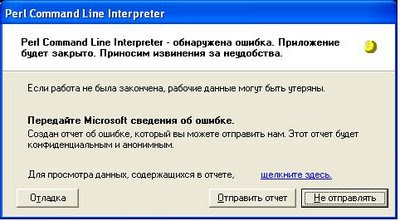

Perl: file or directory
To check this, the prescription says:
When this is used in pair with IO:Dir, which helps you to enumerate contents of a given directory, one non-obvious step should not be forgotten:
if (-d $file)
{
   print $file." is a directory\n";
} else {
   print $file." is a file\n";
}
When this is used in pair with IO:Dir, which helps you to enumerate contents of a given directory, one non-obvious step should not be forgotten:
tie %dir, 'IO::Dir', $dir;
foreach my $entry(keys %dir) {
   next if ($entry eq '.' or $entry eq '..');
   # important part is here: concatenation with the full path
   if (-d $dir."/".$entry)
   {
      print $entry." is a directory\n";
   }
}
Sunday, February 8, 2009
Simple Perl modules
Making it already a rool to post technical details for which I have spent more than 20 minutes, I decided to post as well this.
keywords: How to write perl modules
PageRank: http://www.netalive.org/tinkering/serious-perl/
Answer: it's simple!
Create file StringManip.pm in Lib/ directory where you like with the following contents:
Add the full path to Lib/StringManip.pm to PERL5LIB environment variable. In my case (win32) it is: PERL5LIB=%PERL5LIB%;D:\Programming\Perl
i.e. inside D:\Programming\Perl I have Lib/StringManip.pm. In Linux/Unix: export PERL5LIB=some_path/Lib/StringManip.pm.
Usage snippet:
keywords: How to write perl modules
PageRank: http://www.netalive.org/tinkering/serious-perl/
Answer: it's simple!
Create file StringManip.pm in Lib/ directory where you like with the following contents:
package Lib::StringManip;

use strict;

use base 'Exporter';
our @EXPORT = ('trim');

# Perl trim function to remove whitespace from the start and end of the string
sub trim
{
 my $string = shift;
 $string =~ s/^\s+//;
 $string =~ s/\s+$//;
 return $string;
}

1;
Add the full path to Lib/StringManip.pm to PERL5LIB environment variable. In my case (win32) it is: PERL5LIB=%PERL5LIB%;D:\Programming\Perl
i.e. inside D:\Programming\Perl I have Lib/StringManip.pm. In Linux/Unix: export PERL5LIB=some_path/Lib/StringManip.pm.
Usage snippet:
#!perl -w

use strict;
use Lib::StringManip;

print trim("  trim me!  ");
Thursday, February 5, 2009
Natural Langauge Processing and preparation of a human brain
Having read a number of articles dealing with natural language processing (NLP), cognition and linguistics, like Beyond Zipf's law: Modeling the structure of human language, I come to a conclusion, that NLP in essence is one of the most accurate and non-intruding ways to understand how human brain works.
Compare NLP, for example to neuropsychology.
Compare NLP, for example to neuropsychology.
Subscribe to:
Posts (Atom)